


Commercial Services
Commercial properties demand robust and intelligent security solutions to protect assets, employees, and sensitive information. Professional locksmith services for businesses extend beyond traditional lock and key functions to encompass integrated access control, automatic door systems, and high-security measures.
Rekeying Locks: Adapting Security to Business Needs with New Keys
Commercial rekeying offers a cost-effective and efficient way to update a business's security without the expense of full lock replacement. Key scenarios for commercial rekeying include tenant or employee turnover, where it is essential to ensure previous occupants no longer have access to the premises. In cases of lost or stolen keys, rekeying provides a rapid response, immediately invalidating old keys and preventing unauthorized entry. It can also be part of broader security upgrades, allowing businesses to maintain existing hardware while enhancing access control. After a renovation or service project, rekeying ensures that temporary access granted to contractors is revoked. The benefits include cost-effective security, as it is significantly more affordable than replacing all locks, providing a smart security solution. It also maintains aesthetics by keeping existing door hardware, preserving the consistent look of the commercial property. Furthermore, rekeying offers quick implementation, serving as a fast and efficient way to update security posture, minimizing downtime for businesses.
Master Key Systems: Streamlined Access and Enhanced Control for Businesses
Master key systems provide a sophisticated and highly efficient way to manage access across commercial properties, from small offices to large multi-building complexes. They offer a hierarchical key plan designed for optimal convenience and security. At its core, a master key system allows one key (the master key) to open multiple locks, while individual keys (change keys) are restricted to specific doors. Systems can be designed with multiple levels of access: a change key opens a specific door or a small, designated group of doors (e.g., an individual office) ; a sub-master key provides access to a specific department, floor, or section within a building ; a master key unlocks all cylinders within a particular building or a defined group of locks ; and a Grand Master Key (GMK) is the highest level, capable of unlocking all cylinders across multiple buildings or an entire campus. More complex systems can even extend to "Great Grand Master Keys". These systems are widely adopted in offices, retail stores, warehouses, factories, hotels, municipal facilities, schools, medical centers, multi-tenant buildings, and many more.
Compelling benefits for commercial properties include unmatched convenience, as employees and authorized personnel carry fewer keys, simplifying key management and saving valuable time. Precise controlled access allows businesses to define and limit access to specific areas, ensuring that only authorized individuals can enter sensitive or restricted locations. Robust key tracking and documentation are possible, with modern master key systems integrating with electronic tracking and audit trails, providing a comprehensive record of key distribution and usage for enhanced accountability and security monitoring. Exceptional scalability means the system can be easily modified and expanded to accommodate business growth, new departments, or changes in access requirements without a complete overhaul. Cost-effective key management is another advantage; if a single change key is lost, only the affected locks need rekeying, which is more cost-effective than replacing an entire set of locks. Finally, master key systems provide critical emergency access, enabling authorized personnel to quickly access necessary areas without fumbling for specific keys, which is crucial for safety and rapid response. The security of a master key system is heavily dependent on its design, with systems having fewer hierarchical levels generally offering higher security.


Lock Installation or Replacement: Tailored Security for Every Door
Professional locksmiths install and replace a wide array of commercial locks, each suited for specific security needs. Deadbolt locks are the cornerstone of commercial security, offering superior resistance to physical attacks like picking and brute force. They are essential for all exterior doors and are often combined with a keyed-entry lockset for maximum security. Both single-cylinder (key outside, thumb turn inside) and double-cylinder (key on both sides) options are available, with adherence to building codes that often prioritize single-cylinder for emergency egress. Knob locks, frequently found on interior doors, provide basic privacy but are not recommended for exterior security due to their lower resistance to forced entry. Lever handle locks are popular for interior doors in high-traffic areas due to their ease of use, operating by a simple push-down motion. Mortise locks are known for their exceptional durability and strength, installed within a pocket cut into the door's edge, providing robust security. These are extremely common on aluminum/glass storefronts, but other types are seen throughout various industries. Euro cylinder locks feature a cylinder mechanism that allows for quick and easy cylinder changes without altering the main lock hardware, much like the mortise cylinder. These depend greatly on door thickness and are not always easy to acquire. Smart locks and keypad locks offer modern keyless entry, customizable codes, and remote control capabilities, gaining popularity for their convenience and advanced features. Specialty locks include cabinet locks for securing valuables, padlocks for sheds and gates, and window locks for an added layer of protection.
Locks are rated by ANSI/BHMA (American National Standards Institute/Builders Hardware Manufacturers Association) for their performance and durability. Grade 1 signifies the highest security, typically used in commercial settings but providing excellent protection for residential exterior doors. Grade 2 indicates high security, commonly found on many residential exterior doors. Grade 3 offers basic security, generally suitable for interior doors where privacy is the primary concern. Higher-quality locks often feature hardened steel pins for increased durability and pick resistance, and six-pin systems are more challenging to pick than five-pin systems.
New lock installations are ideal for new construction projects, adding a new layer of security (e.g., a deadbolt to an existing knob lock), or securing new access points. Lock replacement is necessary when existing locks are old, worn out, damaged, or if an upgrade to a stronger, more secure, or technologically advanced locking solution is desired.
The following table provides a summary of common lock types and their security grades:
Lock Type | Primary Uses | Key Features | ANSI/BHMA Security Grade | Best For |
|---|---|---|---|---|
Deadbolt | Exterior / Suite doors | High resistance to attacks, single/double cylinder | 1 and 2 | Exterior, High / Medium Security Areas |
Knob Lock | Common-areas, Interior doors, Privacy | Lock cylinder in knob, Self-latching | 1, 2, and 3 | Interior, Medium / Low Security Areas |
Lever Handle Lock | Interior doors, Medium-traffic Exit-doors | Ease-of-use handle, Lock cylinder in lever, Self-latching | 1, 2, and 3 | Interior, Medium / Low Security Areas, Convenience of use |
Smart/Keypad Lock | Exterior / Interior doors, modern convenience | Keyless entry, customizable codes, remote control, access logs | 1 and 2 | Modern Security, Convenience |
Mortise Lock | Exterior / Interior doors requiring high durability | Installed within door pocket, Mortise cylinder installed in door, High strength | 1 | High-Security, Durability |
Euro Cylinder Lock | Specific Multipoint lock doors | Cylinder easily changeable, depending on door thickness | Varies | Flexibility, Cylinder Swapping |
Astragal Plating: Enhancing Door Security and Integrity
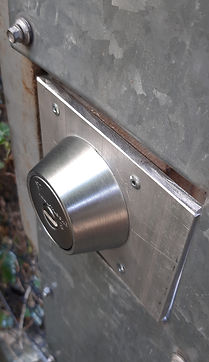
Astragal plating refers to the installation of an astragal, a piece of metal used on a door to seal the gap to protect from accessing the locking connections when closed. An astragal plate is fastened directly to the door itself, and serves multiple critical functions: providing a weather seal, minimizing the passage of light and wind between doors, restricting the passage of smoke and flame during a fire, and most importantly, maintaining security by closing clearance gaps.
Astragal plating can be either prefabricated or custom-made. Prefabricated astragals are standard-sized components that come as part of a door kit or are readily available. They are a good option for straightforward projects or when budget and quick installation are primary concerns. Custom-made astragals, on the other hand, are designed and fabricated specifically for a particular door setup. This is often necessary when purchasing two stock doors to be installed as a double door, accounting for precise measurements, gaps, and specific aesthetic or security requirements. While custom options may have a higher upfront cost, they offer a perfect fit, enhanced durability, and the ability to incorporate unique design elements, potentially leading to long-term cost savings due to fewer repairs. The choice between prefabricated and custom astragal plating depends on the specific needs of the property, including its unique features, budget, and desired level of personalization and security. Lunar Lock Solutions is highly experienced in choosing, fabricating, and installing the correct plating for your application.


Key Extraction: Expert Removal of Broken Keys
Keys can break off in a lock due to wear and tear, poor quality materials, applying excessive force when turning, or issues with the lock itself such as damage or misalignment. This frustrating scenario is more common than generally perceived. Often, the key breaks off flush with the lock, leaving no part to grip.
Attempting to extract a broken key with do-it-yourself methods (like tweezers, super glue, or a saw blade) can often push the key further into the mechanism, damage the lock, or make professional extraction more challenging and costly. Professional locksmiths possess specialized tools, such as extractors and lubricants, specifically designed to safely and efficiently remove broken keys without causing any further damage to the lock or door. Professional extraction is particularly vital when the key is broken off flush, the lock is in a sensitive or high-security area, or when a quick, guaranteed solution is needed to regain access.
High-Security Locks: Fortifying Commercial Property
Commercial properties, especially those with high traffic or valuable assets, are prime targets for unauthorized access and security breaches. Investing in high-security locks is a critical component of a robust security strategy, providing superior protection against sophisticated attack methods. These locks offer enhanced protection against common break-in techniques such as picking, drilling, bumping, and forced entry. They are crucial for safeguarding valuable assets, sensitive data, and the safety of employees and customers.
Leading brands and types for commercial durability include Medeco, renowned for its top-tier quality and unmatched security features, representing a significant investment in superior protection. Corbin/Russwin locks are known for their durability and ability to withstand heavy usage and rough handling, making them ideal for high-traffic commercial environments like schools, hotels, and offices. Yale, a historic name in locks, continues to innovate with advanced digital and high-security options. Professional locksmiths recommend and provide locks meeting ANSI/BHMA Grade 1 and Grade 2 standards, which are designed for superior durability and reliability in commercial applications. Grade 3 is typically intended for residential use, and you won't typically see true high security brand cylinders installed in Grade 3 hardware in a commercial application. High-security locks often incorporate hardened steel pins for increased durability and wear resistance, and more complex pin systems.
Proprietary keyways, such as those offered by Medeco, Primus, Abloy, and others, provide patented and restricted keying options, preventing unauthorized key duplication and further enhancing overall security.



Access Control Systems: Intelligent Security for Businesses
Access control systems are fundamental to modern commercial security, allowing businesses to precisely manage who enters and exits their premises, and when. These systems move beyond traditional keys to offer enhanced security, efficiency, and flexibility. Diverse types of access control solutions are available, including card readers, keypads, hand/fingerprint scanners, key fob remotes, and more. The most commonly used are entry-level systems where users present an identification card or fob to a reader to gain access. Keypads require users to input a unique code to unlock doors and can operate as standalone units or be integrated into a larger, centralized system, and even require dual-level security where a user presents a valid credential to the keypad reader and then enters a code, reducing unauthorized access from a simple theft of ones keys/card. Biometrics, utilizing unique physical attributes like fingerprints or retinal scans, offer a high level of security by authenticating identity. Remote transmitters provide convenience for controlling access to gates or specific doors from a distance. Telephone entry systems allow visitors to communicate with occupants for entry authorization. IP-based access systems operate over existing local or wide area networks (LAN/WAN), allowing for remote electronic access management, and are highly expandable, integrating seamlessly with other security components. Cloud-based systems represent the forefront of access control, enabling remote management from anywhere via a desktop or mobile device, often allowing users to unlock doors with their smartphones, and providing a comprehensive overview of all entry/exit activity.
These systems offer transformative benefits for businesses. They enhance security by precisely restricting access based on customized criteria, preventing unauthorized entry and safeguarding valuable assets and sensitive areas. Efficient management is achieved through centralized control that streamlines user management, allowing for flexible scheduling of access permissions and easy revocation of credentials. Comprehensive audit trails are provided, as modern systems track and log all entry and exit events, offering a detailed record for accountability, security investigations, and identifying potential breaches. Scalability is a key advantage, as systems are easily expandable, adapting to business growth and changing security requirements without needing a complete overhaul. Unparalleled convenience is also gained, as the systems eliminate the hassle of physical keys, offer remote control capabilities, and allow for customized access schedules, improving operational flow.
All of these systems rely on powered hardware, with the exception of mechanical keypad locksets. Electric-strikes are installed into door frames and use small motors or solenoids to allow the keeper to open, which in turn allows the latch of the door to move past it when pulled. Mag-locks (electromagnetic locks) use powerful magnetic attraction to secure doors, offering robust security with no moving parts. Electronic Leversets can be installed with wiring that travels through the door to the frame via either a door transfer cable or a special hinge with wiring concealed within it. There are access control systems that have battery operated leverset solutions with the reader built right in as well. Some of which act as standalone solutions or have the option of using wireless hubs for communicating directly to the overall system. Electric mortise cassettes can be found to either allow the user to turn the handle when authorized, or allow the latch to collapse in on itself, allowing the door to be pushed/pulled open without the need of turning the handle. Any of these options, save for the electric leversets and non-collapsing leversets are to be considered when integrating with an automatic door operator.
Remember however, that all of these solutions need a power supply. The standalone leverset options use batteries which need to be replaced on occasion, while the rest use robust power supply boxes installed nearby on a wall, visibly or hidden in a electrical/telecom area. These power supplies should have a decent sized battery in them to ensure operation during a power-outage. If your access control system does not operate during power outages, call us so that we can help remedy this right away! We are accustomed to repairing oversights of existing installations.
Automatic Door Solutions: Seamless Accessibility and Operational Efficiency
Automatic doors are more than a convenience; they are a strategic asset for commercial properties, significantly enhancing accessibility, operational efficiency, and overall safety. These solutions offer multifaceted benefits for commercial environments. They are crucial for improved accessibility and ADA compliance, creating an inclusive environment by providing barrier-free entry for individuals with physical limitations, those using wheelchairs, or with mobility aids. They are essential for meeting ADA (Americans with Disabilities Act) compliance regulations. Electronic restroom lock kits are available and provide seamless operation for managing traffic into individual use areas, with attractive options for LED indicators as seen in the photo below.

Enhanced convenience and efficiency are also key advantages, as automatic doors facilitate the effortless movement of goods, equipment, and high volumes of foot traffic. Hands-free operation ensures smooth traffic flow and reduced congestion, particularly in busy locations like retail stores, hospitals, and public buildings. Energy efficiency is achieved through smart sensors and timers that ensure doors open only when needed, and that they close promptly. This helps maintain consistent indoor temperatures, leading to significant energy savings and reduced operational costs. Superior safety and security features include motion sensors that detect obstructions, stopping door progression to prevent accidents. When integrated with access control systems, they can restrict operation to authorized personnel or, more commonly, they can be programmed to unlock automatically for anyone to use during certain hours. They can even be set to remain open during emergencies, facilitating swift evacuation, if integrated with the fire system.
Lunar Lock Solutions provide installation and service for a wide range of automatic door operators, including automatic sliding doors, automatic swing doors, and other low-energy auto-operators.

Our Ditec certified technicians ensure that all installations meet stringent safety standards and are compliant with local building codes and ADA regulations.
Regular, scheduled inspections and maintenance, recommended annually, are vital to keep automatic doors in peak working order, ensuring safety and preventing costly repairs by catching small issues early.


Integrations Between Auto-Operators and Access Control Systems: A Unified Ecosystem
The true power of modern commercial security lies in the seamless integration of automatic door solutions with advanced access control systems. This synergy creates a unified, intelligent security ecosystem that optimizes both convenience and protection. Through this integration, businesses gain granular control over who enters and exits, while benefiting from the accessible operation of automatic doors. This ensures that controlled access does not impede efficient traffic flow, nor will it result in security issues. The integration also allows for remote management and monitoring of access points, providing real-time oversight of a facility's security.
Practical examples of integrated solutions include main entrances to businesses that have set operational hours, and wish for the automatic door to be controlled automatically on a timer, or manually by the staff. You don't want the auto-operator to be able to try and open the door when the door is locked, causing wear on the motor. The interior button should always unlock the door and allow egress outside of operating hours to comply with most local mandate. You do not however, want it to successfully trigger the door to unlock when someone unauthorized triggers the exterior the button outside of business hours! (We have seen, and rectified, each of these situations many times.)
A proper setup will allow an employee to present a valid credential to the reader during hours of operations to tell the opening to remain unlocked and allow free use of the auto-operator. This can be done using various credential types such as smartphone apps, PIN codes, or key fobs, all managed through a single, intuitive platform. Systems can be programmed to automatically lock at closing time, ensuring doors are secured automatically and still operate on single entry timing when entered by staff outside of business hours or during specific periods. Crucially, an additional means of cancelling an automatic unlock period can be added either manually with a switch, or through the system, depending on it's capabilities. Integrated systems can also be linked with fire alarm systems, ensuring that doors automatically unlock or remain operational in emergencies, facilitating safe and rapid evacuation. Seamless integration with property management systems and rental booking platforms also streamlines operations for multi-tenant commercial properties.
Call Lunar Lock Solutions today to have us make your system work intelligently.
